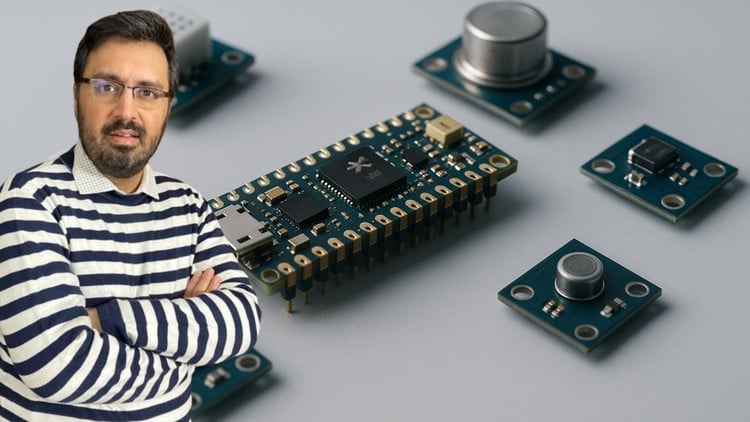
Learn IoT with Edge Devices, Sensors and Real-World Applications in Smart Cities, Industrial Automation & Robotics
What you will learn
Note➛ Make sure your 𝐔𝐝𝐞𝐦𝐲 cart has only this course you're going to enroll it now, Remove all other courses from the 𝐔𝐝𝐞𝐦𝐲 cart before Enrolling!
Understand the difference between IoT, Edge Computing and Edge Machine Learning
Explore the different types of Input & Output Devices
Recognize the different type of pins on an Edge device – Power, Analog, Digital & PWM
Understand the working of an Analog-to-Digital-Converter (ADC)
Deep dive into the working of different serial protocols – UART, SPI and I2C
Delve into the working and real-world use cases of 9 different sensors – vision, humidity, radiation, gas etc.
Compare & contrast 5 popular edge devices like Arduino Nano 33 BLE Sense, Raspberry Pi 5 etc.
Explore TinyML and understand how it differs from Edge Machine Learning
Add-On Information:
- Embark on a foundational journey into the Internet of Things (IoT), gaining a comprehensive grasp of how connected devices seamlessly integrate into our physical world.
- Acquire proficiency in the core architecture of IoT systems, from data acquisition at the “edge” to processing and communication pathways.
- Master the selection and interfacing of diverse sensor technologies, understanding their unique capabilities for capturing environmental and physical data.
- Demystify the role of edge devices as intelligent gateways, capable of local data processing and decision-making before transmission.
- Develop practical skills in connecting and communicating with embedded systems using industry-standard serial protocols, ensuring efficient data flow.
- Gain hands-on experience with popular microcontrollers and single-board computers, learning to program and deploy them for specific IoT tasks.
- Explore the principles of real-time data acquisition and manipulation, essential for responsive and dynamic IoT applications.
- Understand the security considerations inherent in IoT deployments and learn best practices for safeguarding connected systems and data.
- Appreciate the impact of IoT on transforming industries, with a focus on practical examples in smart cities, industrial automation, and robotics.
- Discover the potential of leveraging machine learning algorithms directly on edge devices for intelligent automation and predictive capabilities.
- Foster an innovative mindset to conceptualize and prototype your own IoT solutions for real-world challenges.
- Understand the concept of a distributed computing paradigm where data is processed closer to the source, reducing latency and bandwidth usage.
- Grasp the fundamental principles of creating interactive systems that respond to environmental stimuli.
- Learn to differentiate between various communication paradigms used in IoT for device-to-device and device-to-cloud interactions.
- PROS:
- Build practical, hands-on experience with current IoT hardware and software.
- Develop skills directly applicable to high-demand fields like automation and smart technology.
- CONS:
- A basic understanding of programming is beneficial for optimal learning, although not strictly required.
English
language