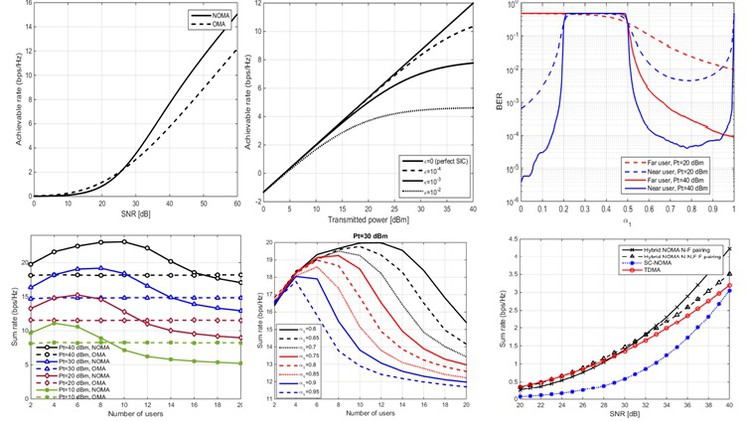
A step by step the Matlab codes for capacity, BER, and outage probability estimations for NOMA communication system
What you will learn
Note➛ Make sure your 𝐔𝐝𝐞𝐦𝐲 cart has only this course you're going to enroll it now, Remove all other courses from the 𝐔𝐝𝐞𝐦𝐲 cart before Enrolling!
What is meant by NOMA with respect to OMA systems?
What is the achievable rate offered by the NOMA, and OMA systems?
What is the effect of imperfect SIC on the downlink NOMA rate capacity?
What is the effect of the NOMA fixed power allocation on the BER performance?
What is the number of users that NOMA can support?
What is meant by the user paring in NOMA?
How to perform fixed and dynamic power allocation in NOMA?
How to estimate the BER, capacity, and outage probability of NOMA communication system over a Rayleigh fading channel?
Add-On Information:
- Course Overview
- This curriculum serves as a comprehensive technical bridge for engineers and researchers looking to master the physical layer complexities of 5G New Radio (NR) standards.
- It emphasizes the practical application of Power Domain Non-Orthogonal Multiple Access (PD-NOMA) to solve the capacity constraints inherent in modern cellular networks.
- The course transitions from abstract mathematical frameworks to executable Matlab environments, ensuring a “learning by doing” approach for complex system modeling.
- Participants explore the mechanics of high-density user environments where spectral resources are shared through superposition coding rather than strictly partitioned.
- By focusing on the interaction between multiple users, the course highlights the shift from 4G orthogonal schemes to the spectral efficiency breakthroughs required for 5G ecosystems.
- Requirements / Prerequisites
- An introductory-level understanding of telecommunication engineering principles, specifically regarding digital signal transmission and reception.
- Prior exposure to Matlab programming, including script management, function creation, and basic multi-dimensional array manipulation.
- Fundamental knowledge of probability and statistics to understand random fading processes and error rate distributions.
- A basic grasp of linear algebra is recommended to follow the mathematical derivations of signal-to-interference-plus-noise ratios (SINR).
- Skills Covered / Tools Used
- Designing Monte Carlo simulations to empirically validate theoretical performance benchmarks in wireless environments.
- Algorithmic implementation of Successive Interference Cancellation (SIC) to decode superposed signals at the receiver side effectively.
- Modeling Power Domain Multiplexing to optimize the distribution of energy across near-field and far-field user equipment.
- Visualizing Spectral Efficiency and system trade-offs through custom-built plotting functions for comparative analysis.
- Utilizing Rayleigh Fading channel models to simulate realistic urban multipath propagation and signal attenuation.
- Debugging and optimizing Matlab code for faster simulation run-times when handling large iterations of data packets.
- Benefits / Outcomes
- Acquire the technical competency to simulate and evaluate the next generation of wireless access technologies independently.
- Develop a comprehensive library of Matlab scripts that can be adapted for academic theses or professional R&D projects.
- Gain a competitive edge in the telecommunications job market by mastering 5G-specific resource allocation and interference management strategies.
- Build a strong foundation for future study in 6G technologies, such as Intelligent Reflecting Surfaces (IRS) or Terahertz communication.
- Learn to interpret complex performance curves, enabling better decision-making in network design and optimization scenarios.
- PROS
- Offers direct translation of complex 5G theory into reusable, modular code blocks.
- Focuses on the most critical performance metrics used in industry-standard technical whitepapers and research journals.
- Provides a granular look at the trade-offs between computational complexity at the receiver and total system throughput.
- CONS
- The high density of mathematical logic and statistical derivation may require students to periodically revisit undergraduate-level engineering mathematics to fully grasp the code’s logic.
English
language